
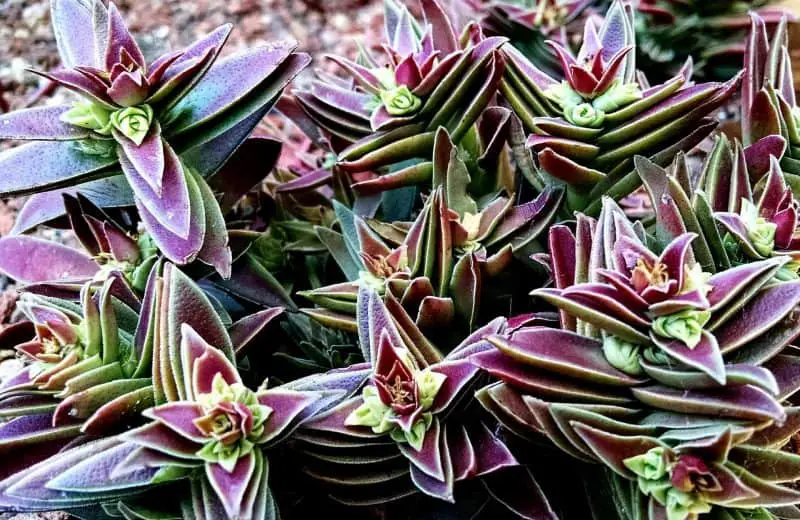
Crassula Corymbulosa care is simple once you understand what this colorful succulent needs most: strong light, fast-draining soil, and careful watering. Often sold as Red Pagoda or Shark’s Tooth, this plant is loved for its stacked leaves and bright red tones.
When grown in the right light, Crassula Corymbulosa develops striking red and purple colors that make it stand out in any succulent collection. In lower light, it often stays green and loses much of its dramatic look.
In this guide, you’ll learn how to grow Red Pagoda indoors, including light, watering, soil, propagation, and how to keep its colors bright and healthy.
What You’ll Learn 🌵
- ☀️ How much light Red Pagoda needs for strong color
- 💧 How to water without causing root rot
- 🪴 The best soil mix and pot setup for healthy roots
- 🌱 Easy ways to propagate from offsets, stems, or leaves
- ✂️ When to repot and divide crowded plants
- ⚠️ Common problems and how to fix them
Quick Answer 🌿
Crassula Corymbulosa grows best indoors in bright light, well-draining soil, and pots with drainage holes. Let the soil dry completely between waterings and give it strong sun to bring out its best red coloration.
Crassula Corymbulosa Varieties
Crassula is a large family of succulents that includes jade plants and many other popular succulents.
Crassula is a genus of succulent plants containing about 200 accepted species, including the popular jade plant (Crassula ovata).They are members of the stonecrop family (Crassulaceae) and are native to many parts of the globe, but cultivated varieties originate almost exclusively from species from the Eastern Cape of South Africa. https://en.wikipedia.org/wiki/Crassula
Crassula Corymbulosa is also known as Crassula Capitella and there are various cultivars of this plant too. It is often sold as Red Pagoda and Shark’s Tooth.
It is a beautiful and easy to care for succulent whatever you call it, and we will discuss Crassula corymbulosa care so you can make it thrive in your garden.
As far as I can tell there are no real differences between the two. Just be aware when you buy them they will probably be green.
How To Care For A Crassula Red Pagoda Video
Crassula Corymbulosa Care
This plant and its varieties are very easy to care for and a great choice for beginning gardeners and succulent enthusiasts alike.
It is exposure to bright light that brings out the striking colors in this plant. When kept under lower light conditions it will remain green.
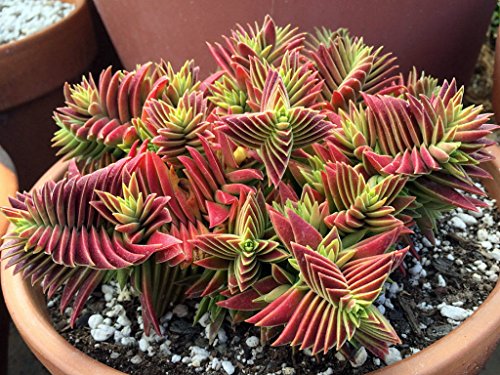
This  Care guide will help you take care of your plant and make it thrive in your garden.
Crassula Corymbulosa is a small, slow-growing succulent that typically reaches about six to ten inches in height.
It has a unique stacked or tiered growth habit that resembles a pagoda and with enough sunlight, it produces pretty red and purple leaves. As a bonus, it produces pretty little white flowers in the summertime.
Crassula Corymbulosa care is not difficult and this plant makes an excellent addition to any succulent collection.
Crassula Corymbulosa Light Requirements
This plant really loves light. In fact, it needs bright light to develop its gorgeous colors. Place it in a south window and it will be happy.
If you don’t give it enough light it will start to etiolate and stretch and become leggy.
If you don’t have a bright enough window for this plant consider getting a LED grow light for your succulent plants.
Best Indoor Locations For Red Pagoda
South-Facing Windows
The best location for strong sunlight and rich red color development.
West-Facing Windows
A strong backup option that provides warm afternoon light.
Sunny Shelves
Great for displaying the stacked growth habit while keeping it close to bright light.
Under Grow Lights
A good option if your natural indoor light is limited.
Crassula Corymbulosa Watering
Like most succulents, this plant grows in a dry climate and stores water in its leaves.
So it likes dry feet. You should water it thoroughly and then allow the pot to drain. Remove any water from its saucer. Then let the soil totally dry before watering again.
Overwatering can cause root rot which can kill your plant so it is better to underwater this plant than to overwater it.
Crassula Corymbulosa Soil
This plant is not picky about its soil as long as it is well draining. You can use a succulent or cactus potting mix or make your own.
You can make your own by using potting soil or coco coir in a 50/50 mix with perlite.
Potting Your Crassula Pagoda Or Shark’s Tooth Plant
It is always a good idea to repot your Crassula succulent after you receive it. Use a pot one size larger than the one it grew in and be sure to use fresh potting media to fill in the new pot.
After that, you may want to repot it every 2 or 3 years unless it gets overcrowded.
Hint: If the pot gets crowded you can remove offsets and use them to make new plants and free up space.
However, it is a good idea to repot it every 2 or 3 years because potting soil does get old and this provides fresh soil for it to grow in.
Crassula Corymbulosa Propagation
Like most other succulents this plant is easy to propagate by using offsets or stem cuttings.
Although it takes longer you can even propagate your Red Pagoda or Shark’s Tooth plant with a single leaf cutting.
Offsets are small plants that grow out from the base of the main plant, and they can be carefully removed and replanted.
Often they will already have some roots attached but if not you can help them along by dipping the end in rooting powder and planting them in a moist potting mix.
Stem cuttings can be taken from the main plant and then planted in well-draining soil.
Remove the bottom few leaves so you have a bare stem to place in your potting soil.
Some people recommend letting them callous over before replanting. I don’t really think this is necessary particularly if you use a rooting hormone to dip the cut end in.
Although it takes longer, you can even propagate your Red Pagoda or Shark’s Tooth plant with a single leaf cutting.
To do this, simply remove a leaf from the main plant and allow it to callous over for a few days.
Once the leaf has calloused, you can then plant it on top of moist well-draining soil.
With a little patience, your new plant will soon take root and begin to grow a new plant from the leaf base.
Crassula Corymbulosa Troubleshooting
Stretching or leggy growth
Usually caused by not enough light. Move it to a brighter location.
Leaves turning soft or mushy
A sign of overwatering or root rot.
Leaves losing color
This usually means it needs stronger light to maintain its red tones.
Wrinkled leaves
Often a sign the plant is thirsty and needs a deep watering.
Leaf drop
Can happen from sudden watering changes or temperature stress.
Crassula Corymbulosa FAQs
How much light does Red Pagoda need?
Bright light is essential. A south-facing window is usually best for strong color.
How often should I water Crassula Corymbulosa?
Only water when the soil is fully dry. This plant does not like wet roots.
Why is my Red Pagoda turning green?
It usually needs more light. Stronger sun helps bring back red and purple tones.
Can I grow Red Pagoda indoors?
Yes, as long as it gets strong light and proper drainage.
Is Red Pagoda easy to propagate?
Yes. Offsets, stem cuttings, and leaf cuttings all work well.
Final Thoughts: Crassula Corymbulosa Care
Crassula Corymbulosa is one of the most eye-catching succulents you can grow, especially when its colors deepen into bright reds and purples. Its stacked growth habit makes it stand out in any collection.
The biggest keys to success are strong light, dry periods between watering, and fast-draining soil. Once those basics are in place, this is a very easy succulent to keep thriving.
If you want a colorful succulent with unique structure, Red Pagoda is an excellent choice for indoor growing.