
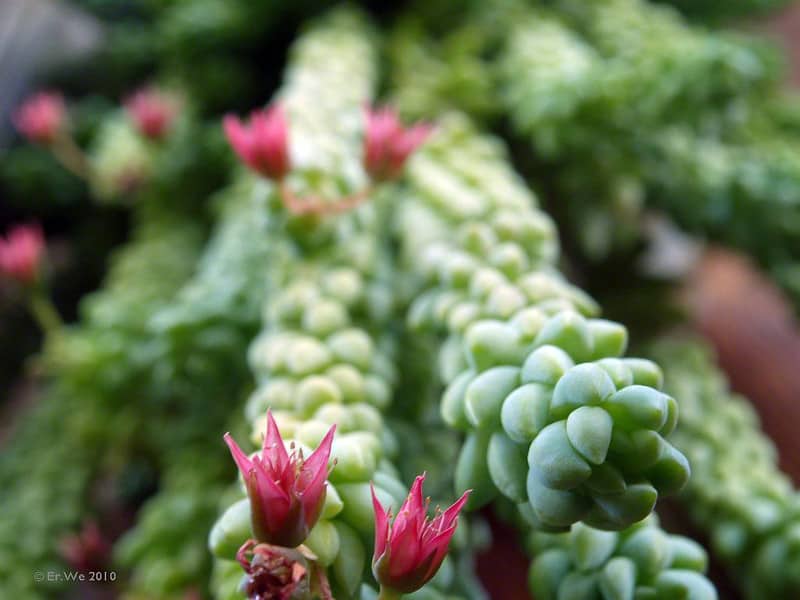
Donkey Tails Plant Care is surprisingly simple once you understand how these trailing succulents grow. Known for their long cascading stems covered in plump leaves, Donkey Tail and Burro Tail plants are popular choices for hanging baskets, shelves, and bright indoor spaces.
While these succulents are low-maintenance, they do have one unique challenge: their leaves detach easily when handled. The good news is that with proper watering, bright light, and well-draining soil, they can thrive indoors for many years.
What You’ll Learn
- How much light Donkey Tail plants need indoors
- The best watering schedule for healthy growth
- How to choose the right soil and container
- How to prevent leaf drop and overwatering problems
- Easy ways to propagate and fill out your plant
Best Indoor Locations for Donkey Tail Plants
Because of their trailing growth habit, Donkey Tail plants look best when displayed where their stems can cascade naturally.
- Hanging baskets: The classic choice for displaying long stems.
- Plant shelves: Allows stems to spill over the edges.
- Bright windows: East and south-facing windows work well.
- Plant stands: Elevating the container highlights the trailing growth.
- Avoid: High-traffic areas where stems may get bumped.
These succulents are known for their trailing stems and red flowers. They make fantastic hanging baskets.


While they are basically low-maintenance plants, there are a few things you should know about how to care for them properly.
In this guide, we will cover everything you need to know about Burro’s Tail Plant Care from watering tips to propagation advice.
What Is A Burro’s Tail Plant?
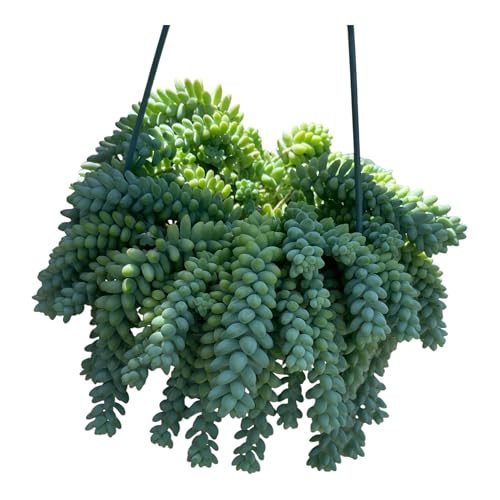
The donkey tails and burro’s tail plant (Sedum morganianum) is a succulent native to Mexico.
The names are often used interchangeably in the plant trade, and to be sure you’ll love whichever one you get.
It gets its name from its long, cascading leaves that resemble a donkey’s tail.
Burro’s tail plants are easy to care for and make a great addition to any home.
They are perfect for those who are new to plant care, as they are very forgiving.
🌵 Donkey Tail vs. Burro Tail: What’s the Difference?
Donkey Tail and Burro Tail often get mixed up, and honestly, it’s easy to see why! They look alike at a glance, but once you get to know them, the differences are as clear as a sunny windowsill.
🪴 Leaf Shape and Texture
- ✨ Donkey Tail (Sedum morganianum): Has longer, pointier, and slightly looser leaves. The leaves are more spaced out and feel a little more fragile to the touch.
- 🌿 Burro Tail (Sedum burrito): Features shorter, plumper, and more rounded leaves that sit snugly together. It’s a bit more compact and forgiving when handled.
📏 Growth Habit
- 🌱 Donkey Tail: Tends to grow longer, with trailing stems that can reach up to 4 feet if happy and left alone.
- 🌵 Burro Tail: Usually stays shorter—more around 1–2 feet—and grows in tighter, fuller clumps.
🧪 Care Similarities
- 💧 Both prefer bright, indirect light and well-draining soil.
- 🪣 Water when the soil is dry—overwatering can cause those juicy leaves to pop off.
- 🌞 Great for hanging baskets where they can cascade down like a succulent waterfall!
🎯 Final Tip
If you’re after a more delicate, airy look, Donkey Tail might win you over. But if you want a tighter, chunkier trailing plant that handles bumps better, Burro Tail is your buddy. Either way, you’re getting a showstopper for your sunny windows or hanging pots.
Donkey Tail vs. Burro Tail Comparison
| Feature | Donkey Tail (Sedum morganianum) |
Burro Tail (Sedum burrito) |
|---|---|---|
| Leaf Shape | Pointed, longer, more spaced | Rounded, shorter, tightly packed |
| Texture | More delicate and fragile | Plump and a bit sturdier |
| Growth Habit | Longer trailing stems (up to 4 ft) | Shorter trails (1–2 ft) |
| Color | Bluish-green | Light green to blue-green |
| Best Use | Dramatic, airy trailing display | Full, compact hanging baskets |
| Care Difficulty | Slightly more fragile | Easier to handle |
Donkey Tails Plant Care
Here is everything you need to know about Burro’s tail plant care!
Burro’s Tail Watering
Watering your burro’s tail plant is one of the most important aspects of care. These plants are native to arid regions and do not like to be overwatered.
How to water a burro’s tail plant
When it comes to watering your burro’s tail plant, the key is to let the soil dry out completely between waterings.
This succulent is native to arid regions of Mexico, so it is used to being in dry conditions.
Watering your plant too often will cause the roots to rot, so be sure to let the soil dry out completely before watering again.
If you are unsure whether or not the soil is dry, stick your finger into the soil. If it feels dry to the touch, then it is time to water your plant.
Another way to tell if your plant needs water is to look at the leaves. If they are starting to wrinkle, that means the plant is thirsty.
When you do water your plant, make sure to use room temperature water. Cold water can shock the plant and cause the leaves to drop off.
Water the plant thoroughly until the water runs out of the bottom of the pot. Then let it drain completely before putting it back in its spot.
Burro’s Tail Propagation
This is an easy plant to propagate and you can use stem cuttings or leaves to make more. Most people will use stems for this.
To propagate your burro’s tail plant, you can either take stem cuttings or leaf cuttings. For stem cuttings, take a cutting that is about four inches long and has several leaves on it.
Dip the cutting in rooting hormone and then plant it in moist well-draining cactus soil. Some people let it callus over before planting and rooting powder is optional.
Place the cutting in a pot of well-draining soil and water it lightly. Place the pot in a bright, sunny spot and keep the soil moist but not wet.
After a few weeks, you should see new roots growing from the bottom of the cutting. Once the roots are established, you can repot it and start watering your plant as usual.
Why Donkey Tail Plants Make Great Houseplants
Donkey Tail plants are popular because they combine unusual appearance with easy care requirements. Their trailing stems create a dramatic display in hanging baskets and elevated containers, while their drought tolerance makes them forgiving for busy plant owners.
These succulents work especially well in apartments, home offices, and bright indoor spaces where their cascading growth habit can be displayed without taking up much floor space.
Because they require infrequent watering and adapt well to containers, Donkey Tail plants are often recommended for beginner succulent growers looking for an attractive trailing plant.
How To Care For A Burro’s Tail Plant When You First Get It
When you first get your burro’s tail plant, it is important to give it a good home. Choose a pot that is slightly larger than the one it came in and has drainage holes.
Fill the pot with well-draining cactus or succulent potting mix and water the plant thoroughly. Allow the soil to dry out completely before watering again.
In its natural habitat, the burro’s tail plant grows on rocky slopes and in crevices. To replicate this environment, use a fast-draining succulent potting mix.
Place the plant in a spot with bright indirect sunlight. Several hours of morning sun is great for it.
Water your burro’s tail plant thoroughly, then allow the soil to dry out completely before watering again.
This plant does not like to sit in wet soil, so be sure to empty any excess water from the saucer after each watering.
If the leaves start to wrinkle or drop off, this is a sign that the plant is not getting enough water.
Burro’s Tail Temperature
The burro’s tail is most comfortable with a temperature range of 65-75 degrees. So if you are comfortable your plant will be fine.
It can tolerate colder temperatures as low as 40 degrees for short periods of time.
But try to avoid putting it in hot or cold places inside the house like air conditioning or heating vents.
Fertilizing Burro’s Tail Succulents
Fertilize your burro’s tail plant once a month during the growing season with a cactus fertilizer or all-purpose succulent fertilizer diluted by half.
Be sure to flush the potting mix with clean water every few months to prevent salt buildup.
If you notice that the leaves of your burro’s tail plant are turning yellow or brown, this is a sign of either too much water or fertilizer. Cut back on watering and fertilizing until the plant recovers.
How To Make Burro’s Tail Fuller
The burro’s tail plant is a slow grower, so don’t be alarmed if it doesn’t seem to be growing much.
Just give it time and it will eventually start to fill out. If you want to encourage faster growth, you can propagate the plant by taking stem cuttings.
You can place stem cuttings directly back into the original pot to make it fuller.
Common Donkey Tail Plant Problems
Why Are My Donkey Tail Leaves Falling Off?
Leaf drop is often caused by handling, moving the plant, or accidental bumps. These succulents naturally have fragile leaves.
Why Is My Donkey Tail Turning Yellow?
Yellow leaves usually indicate overwatering or poor drainage that keeps roots too wet.
Why Are My Donkey Tail Leaves Wrinkled?
Wrinkled leaves are often a sign the plant needs water. Check the soil and water thoroughly if it is completely dry.
Why Is My Donkey Tail Growing Slowly?
Insufficient light is one of the most common causes of slow growth indoors.
Why Is My Donkey Tail Leggy?
Leggy stems with widely spaced leaves usually indicate the plant is stretching toward more light.
Donkey Tails Plant Care FAQs
How Often Should I Water a Donkey Tail Plant?
Allow the soil to dry completely before watering again. Most indoor plants need water every two to three weeks depending on conditions.
Does Donkey Tail Need Direct Sunlight?
Bright indirect light is ideal, although gentle morning sun is usually beneficial.
Why Are the Leaves Falling Off My Donkey Tail?
Leaf drop is often caused by handling or moving the plant because the leaves detach very easily.
Can I Propagate Fallen Leaves?
Yes. Healthy leaves can often root and grow into new plants when placed on moist succulent soil.
What Soil Is Best for Donkey Tail Plants?
A fast-draining mix of coco coir and perlite works well because it prevents excess moisture around the roots.
Donkey Tails Plant Care: Final Thoughts
Donkey Tail plants are among the most distinctive trailing succulents you can grow indoors. Their cascading stems and low-maintenance nature make them excellent choices for hanging baskets, shelves, and bright windows.
Success comes down to providing plenty of light, well-draining soil, and allowing the potting mix to dry between waterings. Avoid overwatering and handle the plant gently to keep its delicate leaves intact.
With a little patience and proper care, your Donkey Tail can become a beautiful trailing centerpiece that continues growing and cascading for years to come.